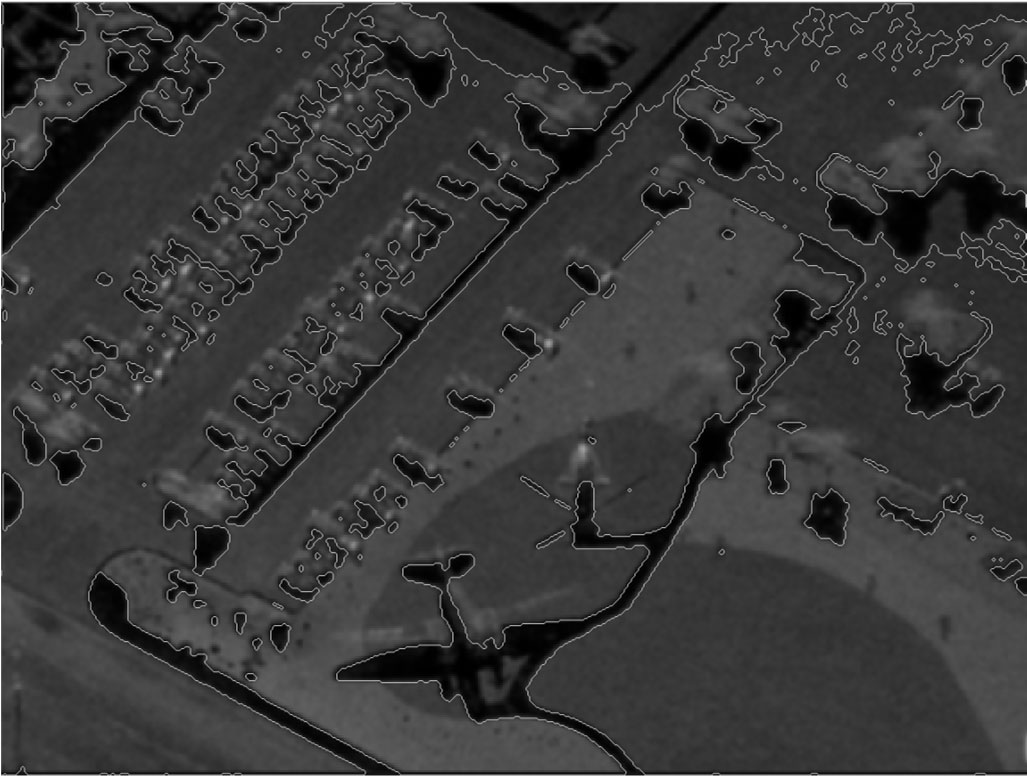
Synthetic Aperture Radar (SAR) provides a capability to get a broad-area images at high resolution independently of weather conditions and daylight. The paper considers image segmentation of surface observation by SAR systems in microwave spectrum. Speckle noise is a typical problem for SAR data processing. We analyse Kuan, Lee, and Frost filters application for speckle reduction. Also, we propose a comparative study of image segmentation considering wavelet decomposition with Daubechies, Symlets, Coiflets, BiorSplines, and Fejer-Korovkin families. Otsu’s method was used for threshold determination in segmentation. Results of investigated SAR image segmentation indicate double decreasing of the number of Binary Large Objects for Kuan image filtering due to noise reduction
European microwave conference in central Europe: EuMCE 2019, International Conference of IEEE
Year of publishing
2019
Citation
DSTU
Kharchenko V.P., Kuzmenko N.S., Ostroumov I.V. An Investigation of Synthetic Aperture Radar Speckle Filtering and Image Segmentation Considering Wavelet Decomposition. European microwave conference in central Europe: EuMCE 2019, International Conference of IEEE. 2019. P. 398-401..
IEEE
V.P. Kharchenko, N.S. Kuzmenko, and I.V. Ostroumov, "An Investigation of Synthetic Aperture Radar Speckle Filtering and Image Segmentation Considering Wavelet Decomposition," European microwave conference in central Europe: EuMCE 2019, International Conference of IEEE , , pp. 398-401.
Harvard
Kharchenko V.P., Kuzmenko N.S., and Ostroumov I.V., 2019, 5. An Investigation of Synthetic Aperture Radar Speckle Filtering and Image Segmentation Considering Wavelet Decomposition. In European microwave conference in central Europe: EuMCE 2019, International Conference of IEEE (pp. 398-401).
Springer
Kharchenko, V.P., Kuzmenko, N.S., Ostroumov, I.V.: An Investigation of Synthetic Aperture Radar Speckle Filtering and Image Segmentation Considering Wavelet Decomposition. In: European microwave conference in central Europe: EuMCE 2019, International Conference of IEEE, pp. 398-401 (2019). .

 Ivan OSTROUMOV, DSc and PhD